
Product Scoping
Feature prioritization, user flow mapping, and technical constraints analysis. We define the minimum feature set that tests your core hypothesis — nothing more, nothing that delays launch.

Build and Launch Your MVP Faster
Startups that launch an MVP before committing to full product development cut initial build costs by 60–70% and reach market validation up to 4 months faster. We scope, architect, and ship minimum viable products in 6-12 weeks - production-ready, investor-demoable, and built to iterate.
Feature prioritization, user flow mapping, and technical constraints analysis. We define the minimum feature set that tests your core hypothesis — nothing more, nothing that delays launch.
We select the stack that balances speed of development, scalability, and ecosystem maturity. For most SaaS MVP projects:
 React
React Next.js
 Flutter
 TypeScript
 Node.js
 Python
 PostgreSQL
 Firebase
 Supabase
 Vercel
 AWS
AWS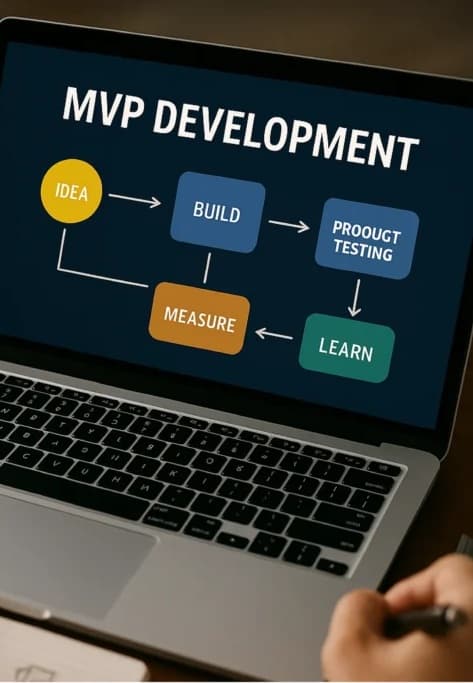
Building a full-featured product before validating demand is the most expensive mistake in startup product development. An MVP lets you test the core value proposition with real users and make architecture decisions based on actual usage patterns, not assumptions.
Test core hypothesis with real users before committing your full development budget
Working MVP demonstrates execution capability and significantly de-risks the pitch
Limit spend while generating the data needed to prioritize the next build phase
Production codebase, not a throwaway — built to grow into your full product
Fixed-scope delivery scoped to the minimum feature set that tests your hypothesis
Scoping session, architecture design, tech stack decision, project kickoff
Authentication, data models, primary user flows
Payments, notifications, admin panel, secondary flows
Bug fixes, performance baseline, cross-device testing
Production release, documentation, repository handoff
Every non-core feature delays validation and increases rebuild cost when you pivot
Throwaway code forces full rewrites when you scale past the first 1,000 users
Unfixed bugs in core flows destroy early user trust and skew your validation data
Without defined criteria before launch, you can't act on the feedback you collect
Over-engineered infrastructure slows MVP cadence and inflates the initial build cost
We provide fixed-scope estimates after a scoping session — contact us to define your MVP scope and get a precise number.
Focused SaaS MVP
Core user flows, authentication, one primary integration. Web-based, production-ready in 6–10 weeks.
Mobile MVP (Flutter)
iOS and Android from a single Flutter codebase with core flows and Stripe or backend API integration.
Complex MVP
Multiple user roles, marketplace mechanics, custom workflows, or compliance-adjacent data handling.
6–12 weeks from scoping call to production launch. Let's define your MVP scope and ship it.

Custom software development is the process of designing, engineering, and deploying software built specifically for one organization's workflows, data model, and technical requirements — as opposed to configuring an off-the-shelf product.
Cost depends on scope and complexity. Focused applications start around $15,000–$30,000. Full SaaS platforms and enterprise systems range from $40,000 to $150,000+. We provide detailed estimates after a scoping session.
A focused application or internal tool takes 6–12 weeks. A full SaaS platform or enterprise system typically requires 4–9 months, depending on integrations and compliance requirements.
For most web applications and SaaS platforms: React or Next.js on the frontend, Node.js or Python on the backend, PostgreSQL for structured data, Redis for caching, and containerized deployment on AWS or GCP with Kubernetes for orchestration.
When off-the-shelf tools require workarounds that slow operations, when licensing costs exceed the value delivered, when you need integrations that existing platforms don't support, or when your product's competitive differentiation depends on proprietary functionality.
SaaS is a subscription-based product built for a broad market. Custom software is engineered for a single organization's specific requirements. You own the codebase, control the roadmap, and pay no per-seat licensing fees.